Most marketing budgets tell the same story: money poured into Instagram ads, TikTok content, maybe a Facebook campaign for good measure — and Pinterest sitting somewhere near the bottom of the list, if it made the list at all. It's treated like an optional extra instead of what it actually is: one of the few remaining channels where organic reach still works, competition is genuinely lower, and the audience arrives already looking to buy.
If your business isn't on Pinterest yet, this isn't a "nice to have someday" gap. It's a real, measurable blind spot — and every quarter it stays unaddressed is a quarter a competitor could be quietly filling it instead.
The Audience You're Missing Isn't Browsing — It's Planning
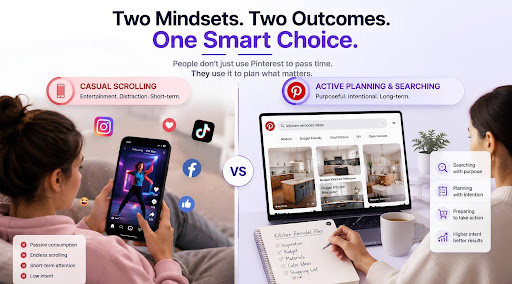
Here's the part that gets lost in most marketing conversations: Pinterest users aren't scrolling to kill time. They're there because they're actively planning something — a home renovation, a wedding, a wardrobe refresh, a business decision, a meal plan for the week. That's a fundamentally different mindset from someone scrolling Instagram between meetings, and it shows up directly in how that traffic behaves once it lands on your site.
A visitor who searched "budget kitchen backsplash ideas" and clicked through to your product page isn't a cold lead. They've already done the mental work of deciding this is something they want — they just need to be shown the right option. That's a warmer visitor than most paid traffic you'd pay to acquire anywhere else.
Why It Gets Overlooked (Even Though the Opportunity Is Real)
Pinterest doesn't get talked about with the same energy as flashier platforms. There's no algorithm drama making headlines every month, no viral dance trend, no constant news cycle keeping it top of mind for marketers deciding where to spend their time. It quietly works in the background for the businesses already using it, without generating the kind of buzz that pulls new businesses in.
That's exactly what makes it valuable right now. Attention in marketing tends to follow noise, not opportunity — and a channel that isn't generating noise is often one where the competition simply hasn't caught up yet.
The Compounding Advantage Nobody Talks About
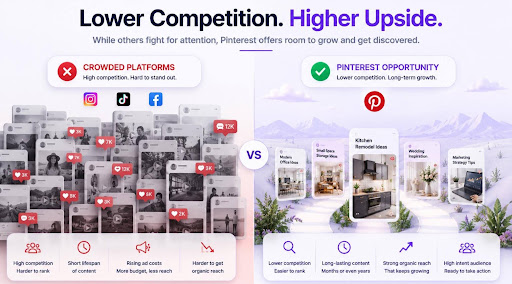
On most platforms, a piece of content works for a day, maybe two, before it's buried under everything posted after it. Pinterest doesn't work that way. Because it functions as a visual search engine rather than a chronological feed, a well-made pin can keep showing up in relevant searches for months — sometimes years — after it was first posted.
This changes the entire economics of content investment. A single strong pin, created once, can keep sending traffic long after the effort to make it is forgotten. Compare that to a platform where yesterday's post is already invisible today, and it becomes clear why an hour spent on Pinterest content often outperforms the same hour spent almost anywhere else, simply because the payoff doesn't expire on a timer.
Lower Competition, Higher Upside
Because so many businesses default to Instagram and TikTok first, entire categories on Pinterest remain genuinely under-served. Search a specific, practical need in a B2B space, a local service industry, or a niche product category, and you'll often find a surprisingly thin field of results compared to how crowded the same search would be on Google or Instagram hashtags.
That gap won't stay open forever. As more businesses catch on — and they will, since Pinterest's advertising and business tools keep improving — the easy wins available today will get harder to claim. Early movers in a given niche tend to build a lead that's difficult for later entrants to fully close, simply because their content has had more time to accumulate saves, clicks, and search relevance.
What This Actually Costs You If You Wait
It's easy to treat "we'll get to Pinterest eventually" as a low-risk decision, since nothing dramatic happens the week you skip it. But the cost isn't dramatic — it's cumulative. Every month without a presence is a month competitors could be building exactly the kind of long-lasting content library that keeps generating traffic on its own. By the time "eventually" arrives, the businesses that started earlier aren't just ahead — they're benefiting from months or years of pins still actively working for them, while you're starting from zero against an established field.
The compounding advantage that makes Pinterest valuable for early movers is the same thing that makes late entry harder. Time in the market matters here more than it does on platforms where old content simply doesn't count for much.
"But My Industry Doesn't Really Fit Pinterest"
This objection comes up constantly, and it's usually based on an outdated picture of the platform. Pinterest has grown well beyond recipes and home décor — B2B software companies pin workflow explainers, financial advisors pin budgeting frameworks, career coaches pin resume templates, and local service businesses pin before-and-after project photos. If what you offer can be explained, planned around, or visually demonstrated in any way, there's very likely already an audience searching for it.
The honest test isn't whether your industry "feels" visual in an obvious way. It's whether people research or plan before choosing what you sell. If they do — and most purchases above a small, impulsive price point involve at least some research — Pinterest is a channel where that research is actively happening, whether your business shows up in it or not.
Getting Started Is Less Work Than You'd Expect
The barrier to entry is genuinely low compared to what most people assume. A free business account, a handful of well-designed pins tied to your existing content or products, and a consistent posting rhythm are enough to start building the kind of long-term search presence described above. You don't need a large team, a big budget, or a completely new content strategy — most businesses already have blog posts, product photos, or guides that can be turned into pins with very little extra effort.
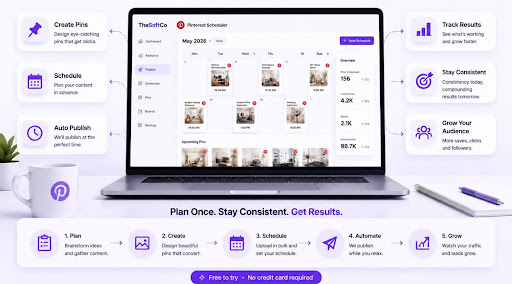
The one habit that trips people up isn't creating the content — it's staying consistent with posting it, especially once the initial motivation wears off. That's a solvable problem rather than a reason to avoid starting; a Pinterest scheduler can carry the weekly posting rhythm on its own once you've batched a month of content, so consistency doesn't depend on remembering to log in every day. It's currently free to try, which removes even the small excuse of cost from the equation — see the pricing details if you want the specifics before committing your time.
The Real Question Isn't "Should We Try Pinterest"
At this point, the question worth asking isn't whether Pinterest could work for your business — for the vast majority of businesses selling something visual, plannable, or research-driven, it can. The real question is how much of the early-mover advantage you're willing to hand to whichever competitor gets there first.
Every quarter this stays on the "someday" list is a quarter of compounding traffic you're not building. Start small if you need to — a handful of pins, a modest posting cadence — but start now rather than next quarter. The businesses that will be glad they started Pinterest in 2026 are the ones starting today, not the ones still planning to get around to it in 2027.
Join the Conversation
Share your perspective, ask thoughtful questions, or leave constructive feedback about this article.