
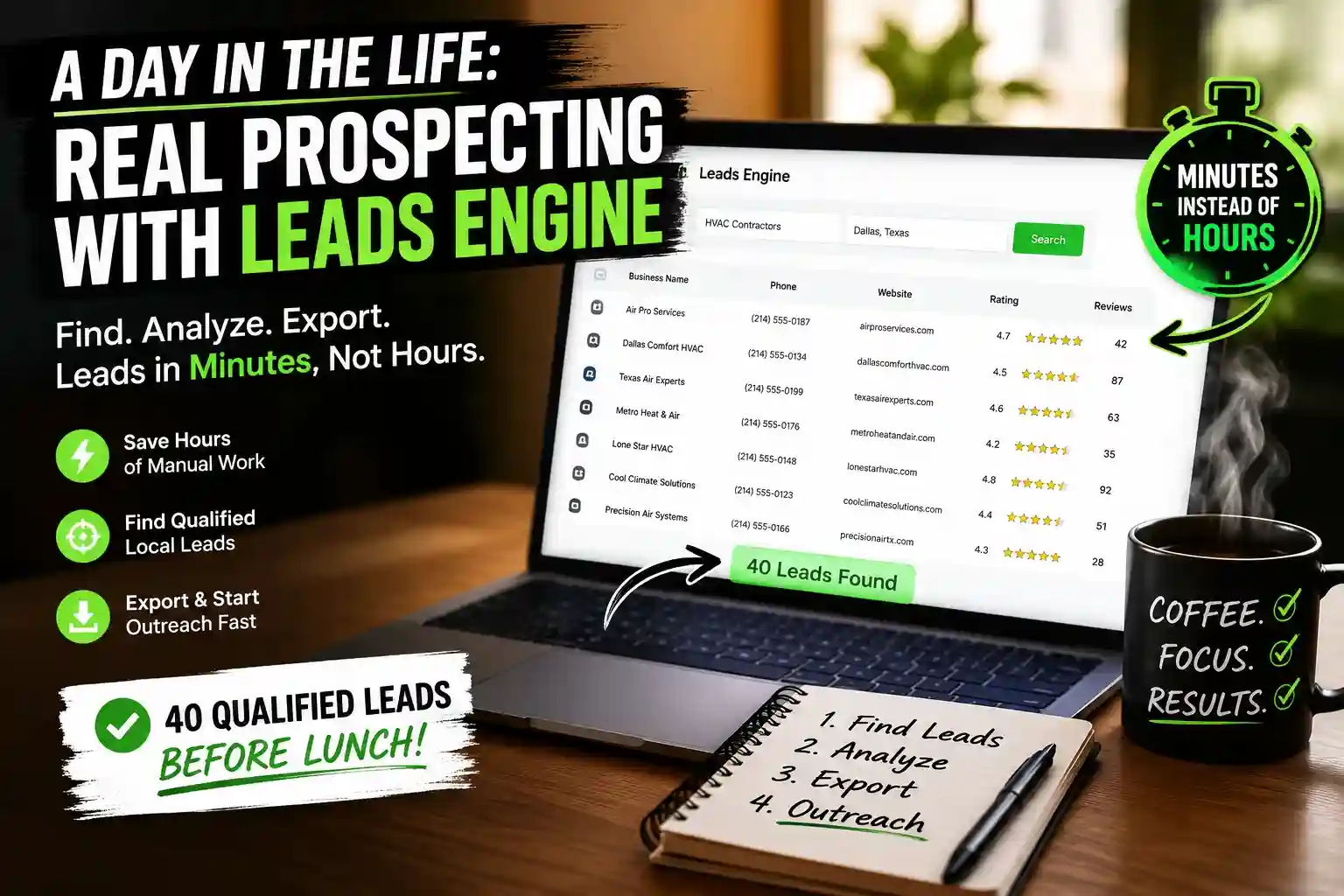
A Day in the Life: What Real Prospecting Looks Like With Leads Engine
It’s Tuesday, just before nine, and you’ve promised a customer forty qualified local leads by Friday. That statement alone would have crushed your morning six months ago. Now it is hardly even a problem. Here’s what really happens between the first sip of coffee and the first “sent” outreach email — and why the space between the two used to be so much bigger.
8:41 AM — The Old Dread, for Comparison
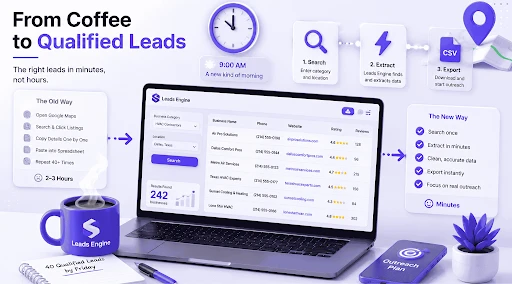
You remember the old routine well enough to still feel it a little. Open Google Maps. Type "HVAC contractors" and a city name. Click the first listing, copy the phone number into a spreadsheet, tab back, click the next one, copy the website if there is one, tab back again. Forty times. Somewhere around listing seventeen, you'd start second-guessing whether this was really the best use of a Tuesday morning — and it wasn't, not even close. That routine used to eat two, sometimes three hours before you'd written a single word to a single prospect.
None of that happens anymore, and it's worth noticing how much mental energy came back along with the time.
9:02 AM — Coffee's Still Hot
You open Leads Engine, type in the category and the city, and hit search. That's genuinely the whole input — no filters to configure, no account settings to dig through first. While the kettle's still steaming on the counter, the results are already loading.
There's something almost anticlimactic about it the first few times you do it. You keep expecting a catch, a loading screen that spins forever, a "please wait, this may take a while" message. It never comes. The list just appears — names, phone numbers, websites, ratings, review counts — and you're already scanning it before the coffee's cooled enough to drink.
9:06 AM — Reading the List Like a Salesperson, Not a Data Entry Clerk
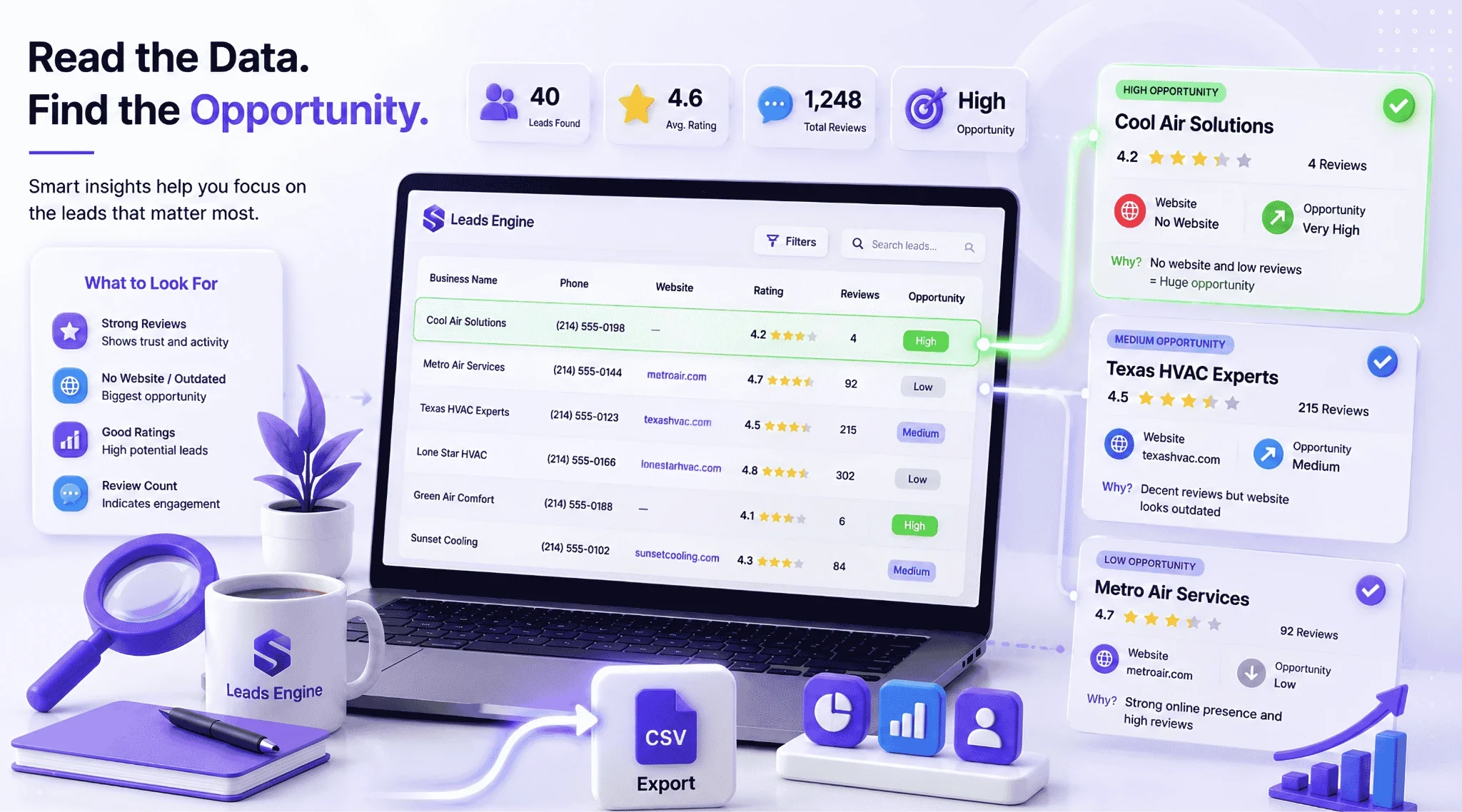
This is the part that actually matters, and it's easy to rush past. A list of forty businesses isn't forty equal opportunities — it's a mix of some that are clearly thriving, some that are quietly struggling, and a few sitting right in the sweet spot where your pitch will land hardest.
You start noticing patterns almost immediately. One contractor has four reviews and no website at all — that's a real conversation waiting to happen. Another has ninety-two reviews and a slick site — probably not your best use of time this week, though worth keeping on file. A third has a decent review count but a website that clearly hasn't been touched since 2019. That one goes straight to the top of your list, because you already know exactly what you're going to say to them.
This is the difference between having data and actually reading it. The information was always going to be sitting in the export either way — what changes is that you have the time and the headspace to actually think about it, instead of still being three names into a two-hour data-entry marathon.
9:14 AM — Exporting and Getting Out of Spreadsheet Mode Fast
One click and the whole list drops into a CSV, ready to paste into whatever you're using to manage outreach — a CRM, a plain spreadsheet, a follow-up tracker, whatever fits your workflow. There's no reformatting, no cleaning up mismatched columns, no manually fixing a phone number that copied over wrong. It just lands the way you need it.
This is the point in the old routine where you'd still be at listing twenty-something, half a coffee cold, wondering if you'd remembered to copy the website URL for the last three entries. Now it's 9:14, and you're already out of spreadsheet mode entirely.
9:20 AM – Composing the First Real E-mail
And here’s the bit that used to feel impossible to imagine: at 9:20, you’re not still gathering data — you’re actually writing to the contractor with the outdated website, addressing the exact item you saw about their site. That message takes genuine thinking, and it should. But it's the only thing that requires some genuine thought this morning, instead of trying to vie for your attention against forty rounds of copy-paste.
If you want the real mechanics of how to convert a list like this into replies, the cold outreach playbook delves deeper into sequencing + follow-ups. So for this Tuesday, we’ll keep it short: one specific observation, one obvious reason it matters, one easy question.
10:30 AM — Because No List Is Ever Perfect
To be fair, not every entry on the list turns out to be gold. One number rings straight to a disconnected line — the business apparently closed sometime in the last few months, faster than any directory could catch up with. That's a normal, expected part of working with real-world data; no source, automated or manual, is going to be right one hundred percent of the time. The difference is what that moment costs you. In the old routine, hitting a dead number after twenty minutes of manual copying felt like a small tragedy. Here, it's a five-second shrug — cross it off, move to the next name, no real time lost, because the rest of the list took no time to build in the first place.
That's the quieter benefit nobody puts in a features list: when gathering the data barely costs you anything, the occasional bad number stops being something you have to protect against. You can just absorb it and keep moving.
By Lunch
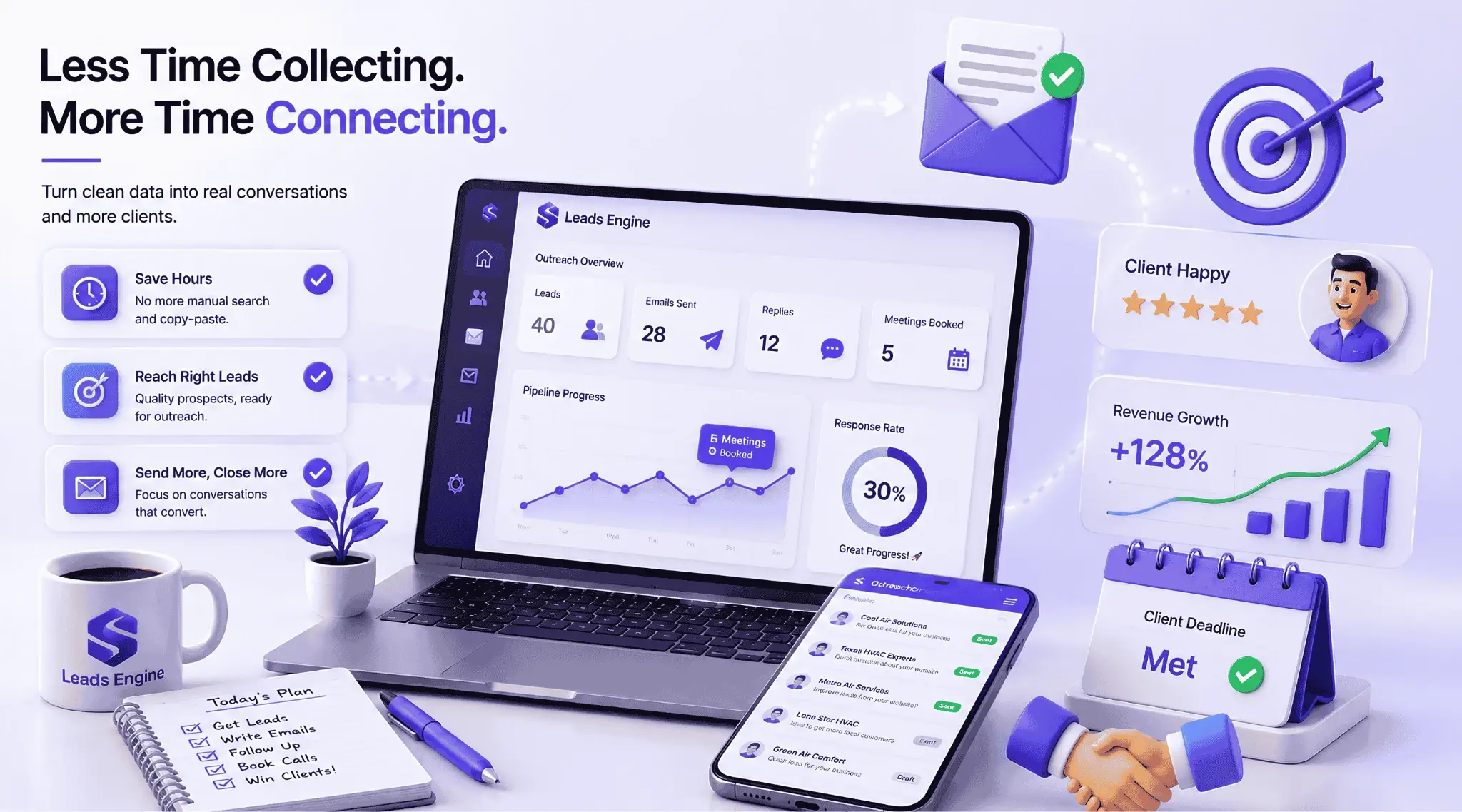
In the old routine, lunchtime on a prospecting day usually meant you were just finishing the list — tired, a little glassy-eyed from scrolling, with the actual outreach still ahead of you for tomorrow. Today, by lunch, four emails are already sent, two more are drafted, and the list itself has been done since before ten. The forty-lead promise to your client isn't a looming deadline anymore; it's basically handled, days ahead of schedule.
 What Actually Changed
It's tempting to describe all this in terms of speed — minutes instead of hours, and that part's true. But the bigger shift is what happens to the rest of your day once the dread of list-building is gone. Prospecting stops being the task you put off until you absolutely have to do it, and starts being something you can fit in before your coffee's even finished. That alone changes how often you do it, and doing it more consistently is most of what separates a steady pipeline from a feast-or-famine one.
There's a version of this Tuesday that repeats every week now, and it barely resembles the version from six months ago. The client deadline is still real, the pressure to find good businesses is still real — what's gone is the three-hour tax on getting started. That's not a small thing. It's the difference between prospecting being a dreaded, occasional chore and it being a normal, forgettable part of a normal morning.
If your Tuesdays still look like the 8:41 AM version of this story, Leads Engine is free to try — no credit card required, and you'll likely have your first list built before you've finished reading this sentence twice.
Join the Conversation
Share your perspective, ask thoughtful questions, or leave constructive feedback about this article.